Stock market corrections often create fear among investors, but for disciplined investors they can open the door to valuable opportunities. The recent fall in the Indian stock market, triggered by rising geopolitical tensions such as the ongoing US–Iran conflict, has once again reminded investors how sensitive markets are to global events.
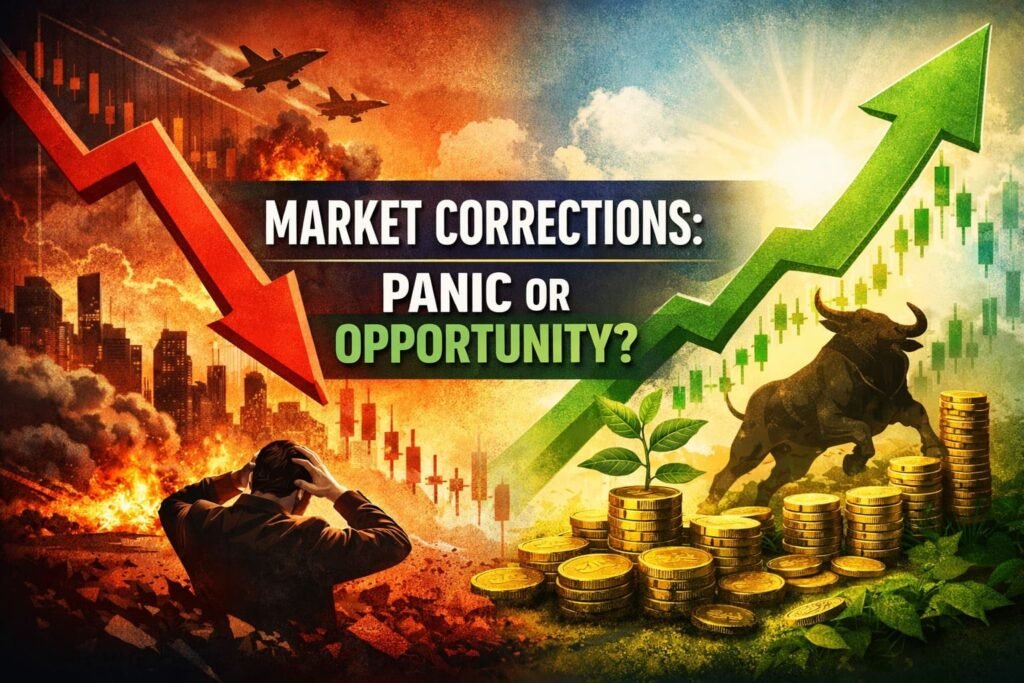
Recent reports suggest that benchmark indices like the Nifty have witnessed sharp declines amid uncertainty surrounding the Middle East situation and rising oil prices, leading to volatility across global markets. Markets dislike uncertainty, and geopolitical conflicts often trigger risk-off sentiment among investors.
However, one important perspective often overlooked is that equity participation in India is still very limited. Despite rapid growth in recent years, only about 9.5% of Indian households invest in securities markets such as stocks or mutual funds, according to a SEBI survey. Even though India now has over 13.6 crore investors and more than 21 crore demat accounts, a large part of the population still prefers traditional investments like real estate, gold, or bank deposits.
This means that the Indian equity market still has significant room for long-term growth as financial awareness increases.
Why Market Corrections Matter
Market corrections of 3–5% or more are not unusual. In fact, they are a natural part of the market cycle. Corrections help remove excess speculation and bring stock prices closer to their intrinsic value.
For long-term investors, such dips can often provide entry opportunities into quality companies at relatively lower valuations. Historically, every major correction has eventually been followed by recovery as economic fundamentals reassert themselves.
The Current Situation: Uncertainty Rules
At the moment, markets remain highly sensitive to geopolitical developments. The ongoing conflict involving the United States and Iran has increased volatility in global markets, impacting oil prices, currencies, and equity indices.
Because of this uncertainty, predicting the short-term direction of the Nifty is extremely difficult. Markets may remain volatile until there is greater clarity.
However, markets also react sharply to positive developments. Even a small rumor or news about a ceasefire or de-escalation could quickly reverse sentiment and push markets upward with equal speed.
The Contrarian Investor Mindset
One of the most powerful investing philosophies comes from legendary investor Warren Buffett, who famously said:
“Be fearful when others are greedy, and be greedy when others are fearful.”
This principle lies at the heart of contrarian investing. When markets are euphoric and valuations are stretched, caution is advisable. But when panic grips the market and prices fall sharply, opportunities often emerge for disciplined investors willing to look beyond short-term noise.
Final Thought
Market volatility is inevitable, but panic is optional. Instead of reacting emotionally to every fall in the market, investors should view corrections as part of the long-term wealth creation journey.
Every big dip has the potential to become a strategic opportunity for fresh investments—provided one focuses on fundamentals, maintains discipline, and keeps a long-term perspective.
Author
Dr. (CA). Meena Goyal
Partner
Pavan Goyal and Associates (Chartered Accountants)
Office No. B212, GO Square, Mankar Chowk, Wakad, Pune 411057
Email – office@goyalca.com
Contact – 9762763351