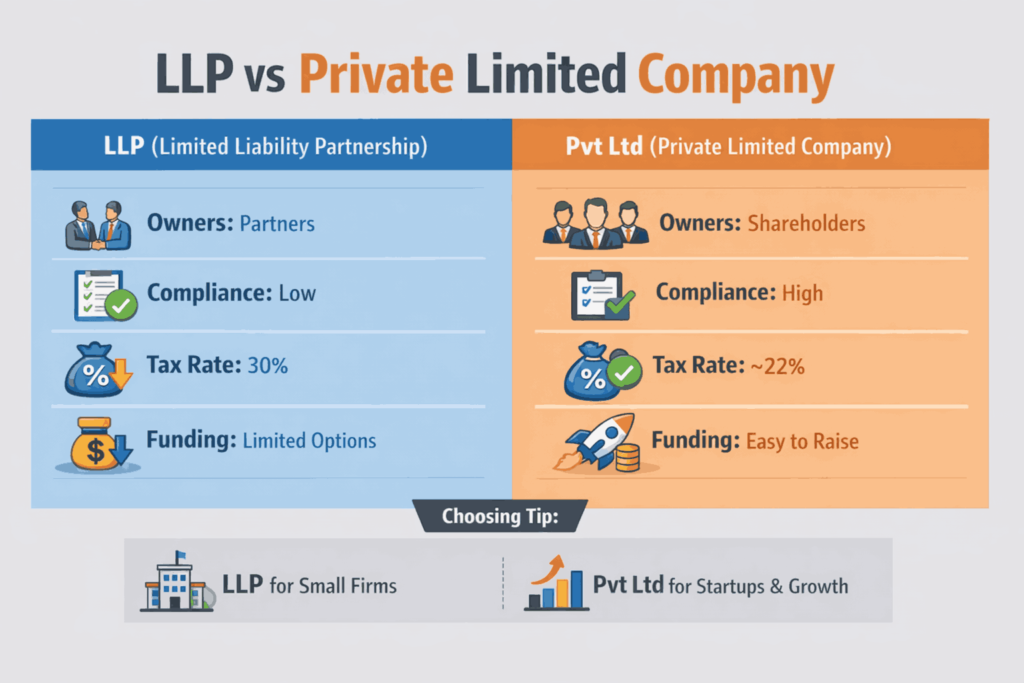
When starting a business in India, one of the first and most important decisions is choosing the right legal structure. The two most popular options are:
- Limited Liability Partnership (LLP)
- Private Limited Company (Pvt Ltd)
Both offer limited liability protection, but they differ significantly in terms of compliance, taxation, funding, and scalability.
This guide explains the difference in simple terms to help you make the right choice.
1. Basic Concept
LLP (Limited Liability Partnership)
An LLP is a partnership where partners manage the business and share profits as per an partnership agreement.
✔ Simple structure
✔ Suitable for small businesses and professionals
Private Limited Company
A company is a separate legal entity owned by shareholders and managed by directors.
✔ More structured
✔ Preferred for startups and growing businesses
2. Ownership & Control
| Particulars | LLP | Private Limited Company |
|---|---|---|
| Owners | Partners | Shareholders |
| Management | Partners themselves | Directors |
| Flexibility | High | Moderate (regulated) |
Key Difference:
In LLP, owners and managers are the same.
In a company, ownership and management are separate.
3. Compliance & Legal Requirements
LLP
- Annual Return (Form 11)
- Statement of Accounts (Form 8)
- Income Tax Return
- Audit only if:
- Turnover > ₹40 lakh OR
- Contribution > ₹25 lakh
✔ Lower compliance burden
✔ Lower professional costs
Private Limited Company
- Mandatory audit (every year)
- Board meetings
- ROC filings
- Maintenance of statutory registers
✔ Higher compliance
✔ More transparency and credibility
4. Taxation (Very Important)
| Particulars | LLP | Company |
|---|---|---|
| Tax rate | 30% | ~22% (optional scheme) |
| Dividend tax | Not applicable | Taxable in shareholder’s hands |
| Profit withdrawal | Easy | Restricted |
Practical Understanding:
- LLP has higher tax rate but simpler taxation
- Company has lower tax rate but additional tax on dividends, thus resulting into double taxation
5. Funding & Growth Potential
LLP
- Cannot issue shares
- Limited funding options
- Not preferred by investors
✔ Best for stable, small businesses
Private Limited Company
- Can issue shares
- Easy to raise funds from:
- Investors
- Venture capital
- Banks
✔ Ideal for startups and expansion
6. Transferability & Exit
| Particulars | LLP | Company |
|---|---|---|
| Ownership transfer | Difficult | Easy (via shares) |
| Investor entry/exit | Limited | Smooth |
7. Real-Life Examples (Simple Understanding)
Example 1: Tech Startup
A group of founders plan to build a SaaS platform and raise funding.
✔ Best choice: Private Limited Company
Reason:
- Investors prefer company structure
- Easy equity dilution
- Better valuation
Example 2: Small Trading Business
A family runs a wholesale trading business.
✔ Best choice: LLP
Reason:
- Low compliance
- No external investors
- Simple structure
8. Quick Decision Guide
| If your goal is… | Choose |
|---|---|
| Low compliance & flexibility | LLP |
| Raising funds & scaling business | Pvt Ltd |
| Professional practice | LLP |
| Startup with growth vision | Pvt Ltd |
9. Final Conclusion
Both LLP and Private Limited Company have their advantages.
- Choose LLP if you want simplicity, flexibility, and lower compliance.
- Choose Private Limited Company if you aim to grow, raise funding, and build a scalable business.
The right choice depends on your business goals, future plans, and funding requirements.
Need Help Choosing the Right Structure?
Selecting the right structure at the beginning can save tax, compliance cost, and future restructuring issues.
We help businesses with:
- Business structure advisory
- LLP & Company registration
- Tax planning & compliance setup
👉 Reach out to us for a consultation and start your business on the right foundation.
Author
Mr. Rohit Jadhav
Intern
Pavan Goyal and Associates (Chartered Accountants)
Office No. B212, GO Square, Mankar Chowk, Wakad, Pune 411057
Email – office@goyalca.com
Contact – 9762763351