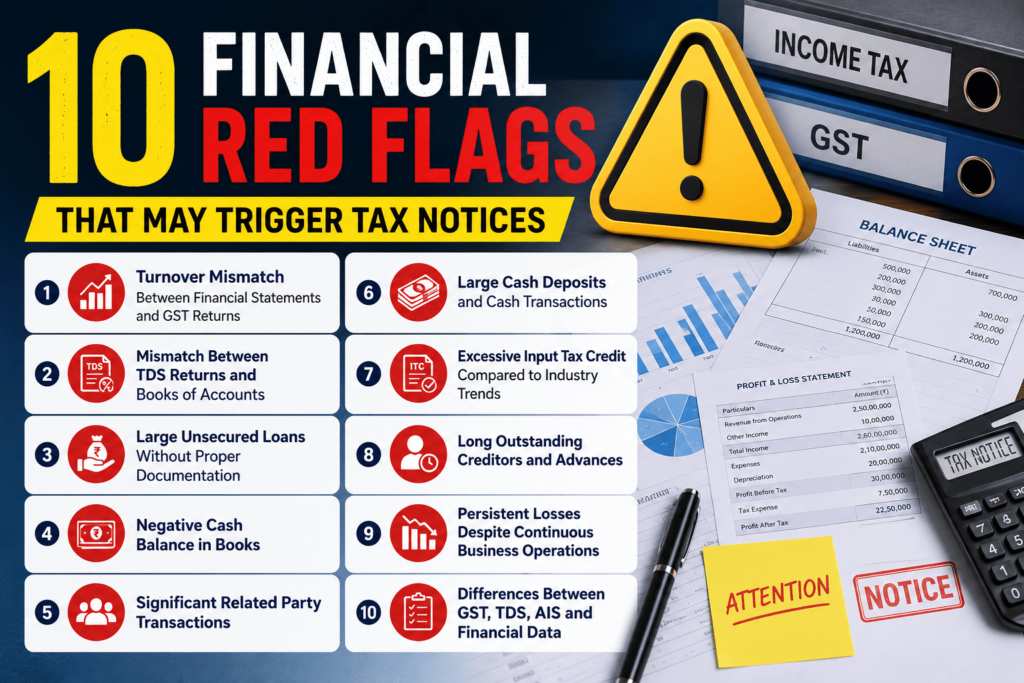
For most businesses, Income Tax and GST notices are not triggered randomly. Modern tax systems rely heavily on data analytics and reconciliation of information reported across income tax returns, GST returns, TDS returns, annual information statements (AIS), e-invoices and financial statements.
The following accounting and reporting issues are among the most common reasons for scrutiny and notices.
1. Turnover Mismatch Between Financial Statements and GST Returns
One of the first checks performed by the tax authorities is the comparison of turnover reported in:
- Financial Statements
- GSTR-1
- GSTR-3B
- Income Tax Return
Differences arising due to accounting treatment, credit notes, export adjustments or timing differences should be properly documented and reconciled.
2. Mismatch Between TDS Returns and Books of Accounts
The Income Tax Department compares:
- Expenses recorded in books,
- TDS returns filed by the company, and
- TDS credits appearing in the recipient’s records.
Failure to deduct TDS or incorrect deduction under wrong sections often results in notices and disallowance of expenditure. This also creates problems for recipients.
3. Large Unsecured Loans Without Proper Documentation
Receipt of substantial loans from directors, relatives or other parties without adequate documentation may invite enquiries Under Section 68 of the Income Tax Act, 1961 (now Section 102 of the new Income Tax Act, 2025) relating to unexplained cash credits.
Businesses should maintain:
- Loan agreements,
- PAN and address proof of lenders,
- Bank statements evidencing transactions, and
- Proof of lender’s financial capacity (Useful in many cases.)
4. Negative Cash Balance in Books
A negative cash balance indicates that the business has spent cash that technically did not exist in the books at that point of time.
Such situations are viewed adversely during assessments and may indicate deficiencies in accounting records or unrecorded transactions. Such instances also mean that incorrect data has been submitted.
5. Significant Related Party Transactions
Transactions with directors, group entities and related parties receive increased scrutiny, particularly where transactions are substantial or recurring.
Proper agreements, approvals and supporting documentation should be maintained to establish commercial justification and arm’s length pricing wherever applicable.
6. Large Cash Deposits and Cash Transactions
Large cash deposits or excessive cash transactions continue to attract attention from tax authorities, particularly where they are inconsistent with the nature or scale of business operations.
Businesses should ensure that cash transactions are properly supported and reconciled with books of account.
7. Excessive Input Tax Credit Compared to Industry Trends
Claiming unusually high Input Tax Credit (ITC) compared to turnover or industry benchmarks may trigger GST verification.
Businesses should periodically review vendor compliance and reconcile ITC with GSTR-2B to avoid disputes.
8. Long Outstanding Creditors and Advances
Credit balances or advances remaining unpaid for several years may invite questions regarding their genuineness and tax treatment.
Periodic review and confirmation of balances can help avoid unnecessary litigation.
9. Persistent Losses Despite Continuous Business Operations
Continuous losses over multiple years while business operations continue normally may attract examination of transfer pricing, expense claims or business arrangements.
Maintaining proper business rationale and supporting records is important in such cases.
10. Differences Between GST, TDS, AIS and Financial Data
Tax authorities increasingly rely on data matching across various filings and information systems. Even genuine businesses may receive notices if reconciliations are not maintained.
An annual reconciliation exercise covering GST returns, TDS returns, books of account, annual information statement (AIS) and financial statements can significantly reduce compliance risks.
Conclusion
Most tax notices arise not because of tax evasion but because of inconsistencies in reporting across different filings and records.
A periodic review of financial statements and tax compliances helps businesses identify potential issues before they attract the attention of the Income Tax Department or GST authorities.
If your business has any of the above indicators, it is advisable to conduct a detailed compliance health check and prepare reconciliations well before assessments or notices arise.
Need Assistance with above concerns?
Contact Us!
Pavan Goyal & Associates helps businesses identify compliance risks and implement practical solutions for sustainable growth.
Author
Pavan Goyal and Associates (Chartered Accountants)
Office No. B212, GO Square, Mankar Chowk, Wakad, Pune 411057
Email – office@goyalca.com
Contact – 9762763351