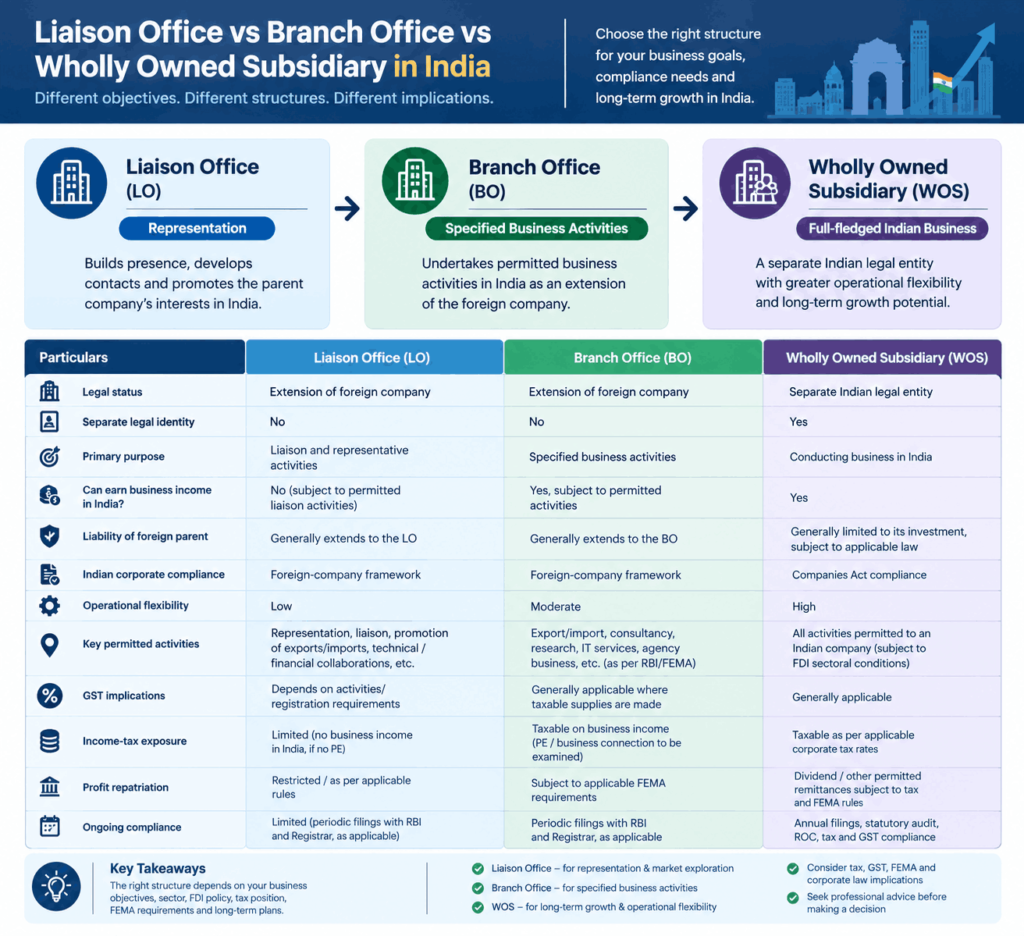
When a foreign company wants to establish a presence in India, one of the first decisions is to determine the appropriate structure.
Depending on the nature and scale of its proposed activities, a foreign business may consider establishing a Liaison Office (LO), Branch Office (BO) or Wholly Owned Subsidiary (WOS) in India.
Each structure has a different legal character, permitted activities, tax implications, regulatory requirements and level of operational flexibility.
Choosing the appropriate structure at the beginning can help avoid regulatory complications and unnecessary costs later.
Liaison Office, Branch Office or WOS – What is the difference?
| Particulars | Liaison Office | Branch Office | Wholly Owned Subsidiary |
|---|---|---|---|
| Legal status | Extension of foreign company | Extension of foreign company | Separate Indian legal entity |
| Separate legal identity | No | No | Yes |
| Primary purpose | Liaison and representative activities | Specified business activities | Conducting business in India |
| Can earn business income in India? | No | Yes, subject to permitted activities | Yes |
| Liability of foreign parent | Generally extends to the LO | Generally extends to the BO | Generally limited to its investment, subject to applicable law |
| Indian corporate compliance | Foreign-company framework | Foreign-company framework | Companies Act compliance |
| Operational flexibility | Low | Moderate | High |
| Suitable for | Market exploration, communication and representation | Specified business operations | Long-term commercial operations in India |
The distinction between an LO/BO and a WOS is fundamental. A Liaison Office and Branch Office are not separate incorporated Indian companies, whereas a WOS is incorporated in India as a separate legal entity.
The Companies Act, 2013 treats a foreign company as a company or body corporate incorporated outside India which has a place of business in India, whether by itself or through an agent, physically or through electronic mode, and conducts business activity in India.
1. Liaison Office – For Representation, Not Business
A Liaison Office is generally intended for activities such as:
- Representing the foreign parent/group company in India;
- Promoting export or import from/to India;
- Promoting technical or financial collaborations; and
- Acting as a communication channel between the foreign parent and Indian businesses.
The important restriction is that an LO is not intended to undertake commercial or business activities in India or earn income from its Indian activities. Your original comparison correctly identifies the representative and communication nature of the LO.
Its expenses are ordinarily funded by the foreign head office through permitted banking channels rather than by conducting revenue-generating business activities in India.
When is an LO suitable?
A Liaison Office can be considered where the foreign company wants to:
Understand the Indian market → develop contacts → communicate with customers/business partners → explore future opportunities
but does not yet want to undertake revenue-generating operations in India.
2. Branch Office – For Specified Business Activities
A Branch Office provides greater operational flexibility than a Liaison Office.
A BO may undertake specified activities permitted under the applicable FEMA framework, including activities such as:
- Export/import of goods;
- Rendering professional or consultancy services;
- Carrying out research work in areas in which the parent company is engaged;
- Promoting technical or financial collaborations;
- Representing the parent company in India;
- Acting as a buying or selling agent, subject to the applicable conditions;
- Providing IT and software-related services; and
- Rendering technical support for products supplied by the parent/group companies.
The activities must remain within the permitted scope and applicable approvals. The RBI framework specifically provides that a foreign entity permitted to establish a branch or liaison office may undertake activities specified under the applicable regulations and cannot undertake other activities unless specifically permitted.
Unlike an LO, a Branch Office can generate income from permitted business activities in India.
3. Wholly Owned Subsidiary – A Separate Indian Company
A Wholly Owned Subsidiary is an Indian company incorporated under the Companies Act, 2013, whose shares are wholly owned by the foreign parent, subject to the applicable foreign investment rules.
Unlike an LO or BO, the WOS is a separate legal entity from its foreign shareholder.
This distinction can be important from both commercial and legal perspectives.
A WOS can generally undertake activities permitted to an Indian company, subject to:
- Its constitutional documents;
- Applicable FDI rules;
- Sectoral restrictions/caps;
- Licensing requirements; and
- Other applicable Indian laws.
For a foreign company intending to establish a long-term business operation in India, a WOS often provides considerably greater flexibility than an LO or BO.
4. Tax Implications
The tax treatment depends significantly on the structure and the activities actually undertaken in India.
Liaison Office
Where the LO strictly performs permitted liaison activities and does not earn income in India, its tax position is different from that of a revenue-generating branch or subsidiary.
However, merely describing an office as an LO does not by itself determine its tax treatment. The actual activities and facts are important.
Branch Office
A BO carrying on taxable business activities in India can be subject to Indian income tax on income taxable in India.
The tax implications should also be examined from the perspective of:
- Permanent establishment;
- Profit attribution;
- Transfer pricing, where applicable;
- Withholding tax; and
- Treaty provisions.
Wholly Owned Subsidiary
A WOS is an Indian company and is generally taxable in India as a domestic company under the applicable income-tax provisions.
The applicable tax rate depends on the regime and conditions applicable to the company. The Income Tax Department’s current guidance recognises different tax regimes/rates for domestic companies depending on eligibility and options exercised.
Therefore, the tax comparison should not be reduced to a simple “LO = no tax, BO = X%, WOS = Y%” formula. The actual activities, taxable income, applicable regime and treaty position must be considered.
5. FEMA and RBI Considerations
LOs and BOs established by foreign entities operate under the FEMA framework applicable to foreign offices in India.
The RBI has prescribed the regulatory framework for establishment of Branch Offices, Liaison Offices and Project Offices in India. Applications and permissions are subject to the applicable FEMA framework and the relevant route/authority.
The original comparison notes the historical requirement relating to the foreign parent’s track record and net worth for LO and BO applications.
However, these requirements and approval mechanisms should always be checked against the current RBI/FEMA framework at the time of establishment, rather than relying on older comparison charts.
6. Companies Act Compliance
A Branch Office or Liaison Office of a foreign company can fall within the foreign-company provisions of the Companies Act, 2013.
For example, Section 380 requires a foreign company establishing a place of business in India to furnish specified constitutional, management and Indian office details to the Registrar.
Section 381 also requires foreign companies to prepare and file financial statements and related documents in accordance with the applicable requirements.
A WOS, on the other hand, is an Indian company and therefore follows the normal corporate compliance framework applicable to companies, including annual financial statements and annual returns.
7. Profit Repatriation
The manner in which funds can be remitted to the foreign parent is another important consideration.
A Branch Office may remit profits outside India subject to the applicable FEMA requirements, banking documentation and payment of applicable Indian taxes. The RBI framework permits remittance of branch profits subject to prescribed conditions.
A WOS can distribute profits to its foreign shareholder through legally permitted mechanisms, such as dividends, subject to applicable tax and FEMA requirements.
A Liaison Office, being non-revenue generating, does not have business profits in the ordinary sense. Funding is generally received from the foreign head office for its permitted activities.
8. Which Structure Should a Foreign Company Choose?
There is no single structure that is best for every foreign company.
| Business objective | Structure generally worth considering |
|---|---|
| Explore the Indian market without commercial operations | Liaison Office |
| Maintain representation and business contacts | Liaison Office |
| Undertake specified business activities without incorporating a separate company | Branch Office |
| Generate business income in India through a foreign-company presence | Branch Office / WOS, depending on facts |
| Build a long-term Indian business | Wholly Owned Subsidiary |
| Ring-fence Indian operations through a separate legal entity | Wholly Owned Subsidiary |
| Scale operations and employ a larger Indian team | Wholly Owned Subsidiary |
The choice should ultimately be based on the proposed activities, sector, FDI policy, taxation, FEMA, liability considerations, repatriation requirements and expected scale of Indian operations.
9. A Practical Decision Framework
A foreign business can broadly ask:
Do we only want to explore and represent?
Consider a Liaison Office.
Do we want to undertake specified activities in India but operate as an extension of the foreign company?
Consider a Branch Office.
Do we intend to build an independent and scalable Indian business?
Consider a Wholly Owned Subsidiary.
The answer should be finalised only after checking the applicable FDI/FEMA rules, sector-specific requirements, tax implications and commercial objectives.
Conclusion
Selecting the right structure is one of the most important decisions for a foreign company entering India.
A Liaison Office is primarily suited for representation and market-development activities and cannot ordinarily undertake revenue-generating business activities.
A Branch Office allows specified business activities in India but remains an extension of the foreign company.
A Wholly Owned Subsidiary, on the other hand, is a separate Indian legal entity and generally offers the greatest flexibility for conducting and expanding business in India.
The right structure therefore depends not merely on the cost of incorporation, but on the foreign company’s long-term business plan, permitted activities, tax position, FEMA requirements, liability exposure and regulatory obligations.
Before establishing a presence in India, foreign businesses should undertake a proper tax, FEMA, corporate-law and GST assessment so that the chosen structure remains suitable as the Indian operations grow.
Need Assistance with above concerns?
Contact Us!
Pavan Goyal & Associates helps businesses identify compliance risks and implement practical solutions for sustainable growth.
Author
Pavan Goyal and Associates (Chartered Accountants)
Office No. B212, GO Square, Mankar Chowk, Wakad, Pune 411057
Email – office@goyalca.com
Contact – 9762763351