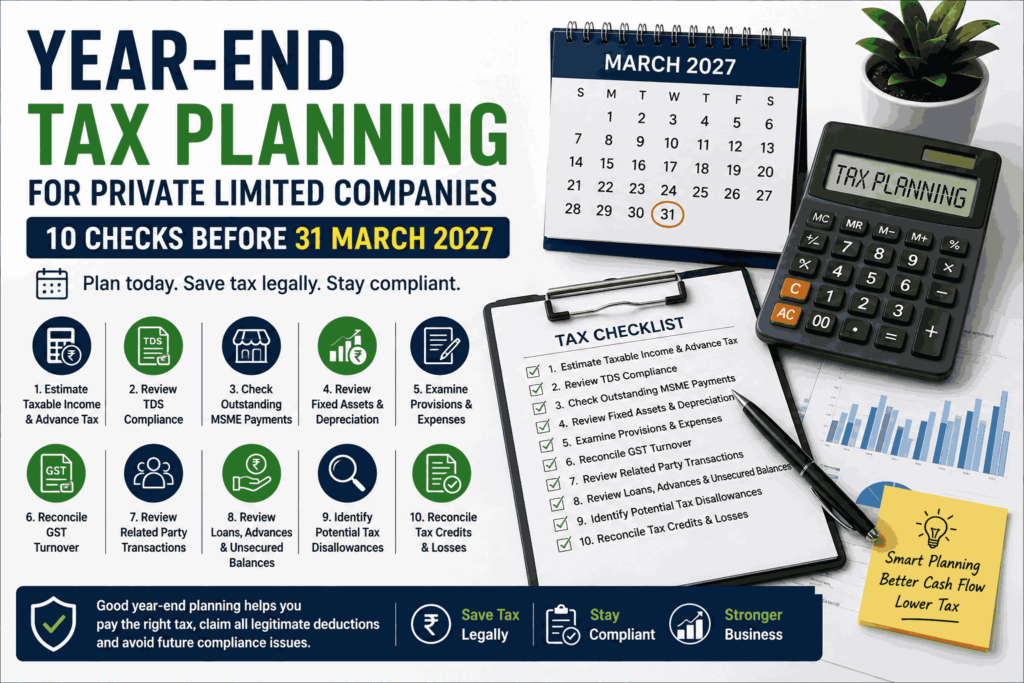
The financial year 2026–27 is the first full financial year governed by the Income-tax Act, 2025. As 31 March 2027 approaches, private limited companies should review their tax position, pending compliances and major transactions before closing their books.
Effective from 1 April 2026, the Income-tax Act, 2025 has introduced the Tax Year concept. Accordingly, income earned from 1 April 2026 to 31 March 2027 will relate to Tax Year 2026–27.
Year-end tax planning is not about creating artificial expenses or transactions. It is about identifying genuine tax adjustments, completing required compliances and ensuring that the company claims all legitimate deductions.
1. Estimate the Final Tax Liability
Prepare a provisional tax computation based on the expected profit for Tax Year 2026–27.
Review:
- Estimated taxable income;
- Tax already deducted/collected;
- Advance tax paid;
- Major tax disallowances;
- Depreciation; and
- Brought-forward losses and eligible tax credits.
For Tax Year 2026–27, advance-tax compliance is governed by the Income-tax Act, 2025. The overall advance-tax framework remains broadly unchanged, and the final instalment is due by 15 March 2027.
2. Review TDS Compliance
Before 31 March, reconcile TDS relating to payments such as:
- Professional fees;
- Contractor payments;
- Rent;
- Interest;
- Commission; and
- Payments to directors.
Check that TDS has been correctly deducted, deposited and reported.
For payments relating to Tax Year 2026–27, the TDS provisions of the Income-tax Act, 2025 apply.
3. Check Outstanding MSME Payments
Review all outstanding balances payable to micro and small enterprises.
The company should identify vendors covered by the applicable MSME provisions and examine whether delayed payments could affect the timing of income-tax deduction.
Maintain proper vendor confirmations and supporting records rather than waiting until the tax return is being prepared.
4. Review Fixed Assets and Depreciation
Prepare a year-end review of additions and disposals of fixed assets.
Check:
- Date of acquisition;
- Date assets were put to use;
- Capital work-in-progress;
- Assets sold during the year;
- Book depreciation; and
- Tax depreciation.
Book depreciation and tax depreciation may differ, and the correct tax adjustment should be incorporated in the year-end computation.
5. Examine Provisions and Outstanding Expenses
Review provisions created for expenses such as bonuses, incentives, professional fees, repairs and other estimated liabilities.
An expense recorded in the Profit & Loss Account is not automatically deductible for income-tax purposes. The applicable tax provisions and the nature and timing of the liability should be examined before finalising the tax computation.
6. Reconcile GST Turnover With the Books
Perform a year-end reconciliation between:
Books of Account ↔ GSTR-1 ↔ GSTR-3B ↔ E-Invoices
Investigate differences relating to:
- Credit notes;
- Export turnover;
- Advances;
- Sale of fixed assets;
- Other operating income;
- Timing differences; and
- Unreported or incorrectly reported invoices.
A proper reconciliation can help prevent both GST and income-tax queries arising from turnover mismatches.
7. Review Director and Related-Party Transactions
Review transactions with directors, shareholders, group companies and other related parties.
Particular attention should be given to:
- Director’s current accounts;
- Personal expenses paid by the company;
- Loans and advances;
- Interest-free transactions;
- Management fees; and
- Payments to group entities.
Such transactions may have implications under income-tax, GST and company law and should be appropriately documented.
8. Review Loans, Advances and Unsecured Balances
Before year-end, review major outstanding loans and advances.
Check whether:
- Confirmations are available;
- Interest is appropriately accounted for;
- Recoverability has been assessed;
- Related-party implications arise; and
- Any statutory or tax adjustment is required.
Special attention should be given to long-standing balances and transactions with promoters or group companies.
9. Identify Potential Tax Disallowances
The year-end tax computation should specifically identify expenses that may require adjustment.
Common areas include:
- Personal expenditure;
- Capital expenditure;
- Certain expenditure prohibited by law;
- Expenses affected by TDS non-compliance;
- Expenses relating to exempt income, where applicable; and
- Other expenses subject to specific statutory conditions.
The new Income-tax Act, 2025 contains specific provisions governing the allowability of business expenditure, and accounting treatment alone does not determine tax deductibility.
10. Reconcile Tax Credits and Earlier-Year Positions
Finally, reconcile the company’s tax records with the information available on the income-tax portal.
Review:
- TDS/TCS credits;
- Advance tax payments;
- Outstanding demands;
- Brought-forward losses;
- Unabsorbed depreciation; and
- Eligible MAT/AMT credit, wherever applicable.
The Income Tax Department has confirmed that eligible unutilised MAT/AMT credits under the old Act continue to be recognised under the Income-tax Act, 2025, subject to the applicable conditions.
Conclusion
31 March 2027 is more than the closing date for the financial statements. It is an important tax-planning checkpoint for companies.
A timely review of taxable income, TDS, MSME payments, depreciation, provisions, GST reconciliation, related-party transactions, loans and tax credits can help identify issues before they become problems.
For Tax Year 2026–27, companies should also ensure that their tax computations and compliance processes are aligned with the Income-tax Act, 2025, which applies to income earned from 1 April 2026 onwards.
Good year-end tax planning is not about avoiding tax—it is about paying the correct tax, claiming legitimate deductions and maintaining proper documentation.
Need Assistance with above concerns?
Contact Us!Pavan Goyal & Associates helps businesses identify compliance risks and implement practical solutions for sustainable growth.
Author
Pavan Goyal and Associates (Chartered Accountants)
Office No. B212, GO Square, Mankar Chowk, Wakad, Pune 411057
Email – office@goyalca.com
Contact – 9762763351