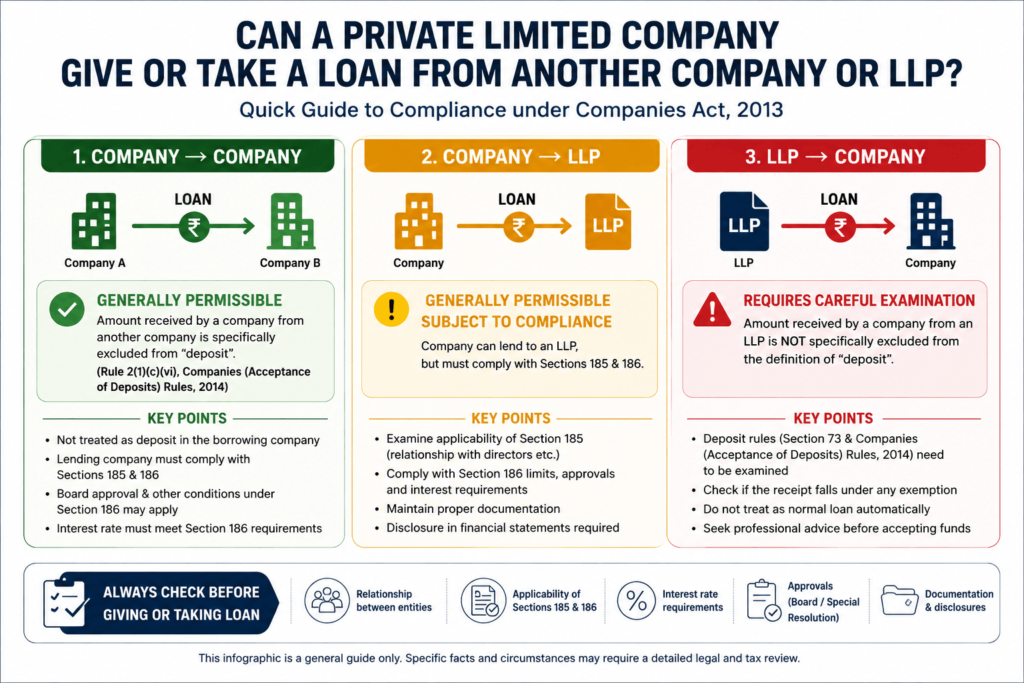
Loans between group entities, sister concerns, private companies and LLPs are common in closely held businesses. However, a simple transfer of funds between two entities can have important implications under the Companies Act, 2013, particularly Sections 73, 179, 185 and 186, as well as the Companies (Acceptance of Deposits) Rules, 2014.
A common question is:
Can a Private Limited Company take a loan from another company or LLP? Can it also give a loan to an LLP or another company?
The answer depends upon whether the entity giving or receiving the loan is a company or an LLP and, importantly, on the relationship between the entities.
1. Can a Private Limited Company take a loan from another company?
Yes.
A company can generally borrow money from another company.
Importantly, an amount received by a company from any other company is specifically excluded from the definition of “deposit” under Rule 2(1)(c)(vi) of the Companies (Acceptance of Deposits) Rules, 2014. Therefore, a normal inter-company loan does not become a “deposit” merely because it is received by the borrowing company.
For example:
Company A → Loan → Company B
Company B can generally receive the loan from Company A without treating it as a deposit under the deposit rules.
However, the lending company must independently examine whether it is permitted to give the loan under Section 186 and whether Section 185 applies because of the relationship between the entities.
2. Can a Private Limited Company take a loan from an LLP?
This requires greater caution.
An LLP is a body corporate under Section 3 of the Limited Liability Partnership Act, 2008. However, for the purpose of the specific exclusion from “deposit” under Rule 2(1)(c)(vi) of the Companies (Acceptance of Deposits) Rules, the wording is specifically:
amount received by a company from any other company.
Therefore, an LLP should not automatically be equated with a company for this particular deposit exclusion.
Consequently:
Loan from Company → generally excluded from deposit
Loan from LLP → deposit rules need to be examined
This is an important distinction and should not be overlooked merely because an LLP is a body corporate.
Practical implication
If an LLP proposes to lend ₹50 lakh to a private limited company, the company should first examine whether the proposed receipt qualifies under any of the exclusions/exemptions under the Companies (Acceptance of Deposits) Rules.
It should not simply record the amount as “Loan from LLP” and assume that the deposit provisions do not apply.
3. Can a Private Limited Company give a loan to another company?
Yes, subject to Section 186.
Section 186 of the Companies Act regulates loans, guarantees, securities and investments made by a company.
Subject to the applicable provisions, a company can provide a loan to another company.
However, the following should be examined:
- Board approval;
- Section 186 limits;
- Special resolution, where applicable;
- Interest rate requirements;
- Disclosure requirements;
- Maintenance of statutory records; and
- Section 185, wherever applicable because of the relationship between the entities.
The Board’s approval for transactions covered by Section 186 is required by a resolution passed at a meeting of the Board with the consent of all directors present at the meeting.
4. What is the Section 186 limit?
A company cannot, without the approval of members by a special resolution, give loans, guarantees or securities or make investments beyond the prescribed overall limits.
Broadly, the threshold is:
60% of paid-up share capital + free reserves + securities premium account
OR
100% of free reserves + securities premium account
whichever is higher.
The limit is considered with reference to the aggregate of the company’s loans, guarantees, securities and investments covered by Section 186.
Therefore, before a company gives a substantial loan to another entity, the existing loans, investments, guarantees and securities should also be reviewed.
5. Is a loan required to carry interest?
Yes, Section 186 contains a specific requirement regarding the rate of interest for loans covered by the section.
The rate of interest should not be lower than the prevailing yield of the one-year, three-year, five-year or ten-year Government Security closest to the tenor of the loan.
Accordingly, interest-free or very low-interest loans between companies should not be entered into without first examining the applicability of Section 186 and the relevant exemptions.
6. When does Section 185 become relevant?
Section 185 deals with loans to directors and persons in whom directors are interested.
The provision is particularly important where the borrower is:
- A director;
- A relative/partner falling within the specified provisions;
- A private company in which the relevant director is a director or member; or
- A body corporate falling within the specified conditions of Section 185(2).
Section 185(2) permits certain loans to a person in whom a director is interested subject to conditions including approval by special resolution and utilisation of the loan by the borrowing company for its principal business activities.
Therefore, when two companies have common directors or common ownership, Section 185 should be checked before the loan is sanctioned.
7. What if the borrowing company is a sister concern?
Consider this example:
Mr. A owns 80% of Company X
Mr. A owns 80% of Company Y
Company X proposes to lend ₹1 crore to Company Y.
The fact that both companies belong to the same promoter group does not by itself make the transaction prohibited.
However, the company should examine:
- Section 185;
- Section 186;
- Board approvals;
- Special resolution requirements, if applicable;
- Interest rate requirements;
- Related-party implications;
- Financial statement disclosures; and
- Whether the funds will be used for the borrowing company’s principal business activities, wherever Section 185(2) applies.
8. Can a Private Limited Company give a loan to an LLP?
Generally, a company can lend to an LLP, but the Companies Act requirements need to be examined.
Section 186 applies to loans made by a company and therefore the lending company should examine its Section 186 compliance.
In addition, if the LLP has a particular relationship with the directors of the lending company, the applicability of Section 185 should also be examined.
The fact that the borrower is an LLP does not, by itself, make the loan impermissible.
However, the relationship between the LLP and the directors of the lending company can become important.
9. Can an LLP give a loan to a Private Limited Company?
This is the area where businesses should exercise particular caution.
An LLP is a body corporate under the LLP Act, but the deposit exclusion under Rule 2(1)(c)(vi) refers specifically to amounts received from another company.
Therefore, a private company receiving money from an LLP should examine whether the receipt falls within any permissible category under the Companies Act and Deposit Rules.
The analysis should be made before accepting the funds, rather than after the loan has already been received.
10. Simple comparison
| Transaction | Broad position | Key provisions to examine |
|---|---|---|
| Company receives loan from another Company | Generally permissible; excluded from “deposit” | Deposit Rules |
| Company receives loan from LLP | Requires specific deposit-rule analysis | Section 73 + Deposit Rules |
| Company gives loan to another Company | Generally permissible subject to conditions | Sections 185 & 186 |
| Company gives loan to LLP | Generally permissible subject to conditions | Sections 185 & 186 |
| Company gives loan to sister concern | Possible, but relationship must be examined | Sections 185, 186 & 188 |
| Company gives loan to company having common directors | Possible in appropriate circumstances, subject to Section 185/186 | Sections 185 & 186 |
| LLP gives loan to Company | Requires examination by borrowing company under deposit rules | Section 73 + Deposit Rules |
11. Documentation should not be ignored
Even where the transaction is legally permissible, proper documentation is important.
A company entering into an inter-entity loan should ordinarily maintain:
- Loan agreement;
- Board resolution;
- Special resolution, where required;
- Interest rate and repayment terms;
- Bank trail;
- Purpose of the loan;
- Security/collateral details, if any;
- Confirmation of outstanding balance; and
- Appropriate financial statement disclosures.
For related entities, documentation should clearly establish the commercial rationale for the transaction.
12. What should companies check before transferring funds?
Before giving or accepting a substantial inter-company or LLP loan, management should ask five questions:
1. Who is giving the money?
Company, LLP, director, shareholder, promoter or third party?
2. Who is receiving the money?
Company, LLP, director or another related entity?
3. Is the receipt covered by the deposit rules?
This is particularly important where the lender is an LLP rather than a company.
4. Does Section 185 or 186 apply?
The relationship between the parties and the amount of the loan should be examined.
5. Have all approvals and documentation been completed?
Board approval, special resolution, agreements, interest terms, disclosures and statutory records should be reviewed as applicable.
Conclusion
A Private Limited Company can generally give or receive loans from other entities, but the legal treatment is not identical for a company and an LLP.
The most important distinction is that a loan received by a company from another company is specifically excluded from the definition of “deposit” under the Companies (Acceptance of Deposits) Rules, 2014. A loan received from an LLP, however, requires a separate examination because the relevant exclusion refers specifically to amounts received from another company.
Similarly, when a company gives a loan, Sections 185 and 186 should be examined before the transaction is entered into, particularly where the parties have common directors, shareholders or other relationships.
Therefore, before transferring funds between group entities, companies should determine the legal character of the transaction, applicable approvals, deposit implications, interest requirements and related-party considerations.
A properly documented loan transaction can be a useful way of managing group cash flows. An incorrectly structured transaction, however, can create avoidable Companies Act compliance issues.
Need Assistance with above concerns?
Contact Us!
Pavan Goyal & Associates helps businesses identify compliance risks and implement practical solutions for sustainable growth.
Author
Pavan Goyal and Associates (Chartered Accountants)
Office No. B212, GO Square, Mankar Chowk, Wakad, Pune 411057
Email – office@goyalca.com
Contact – 9762763351