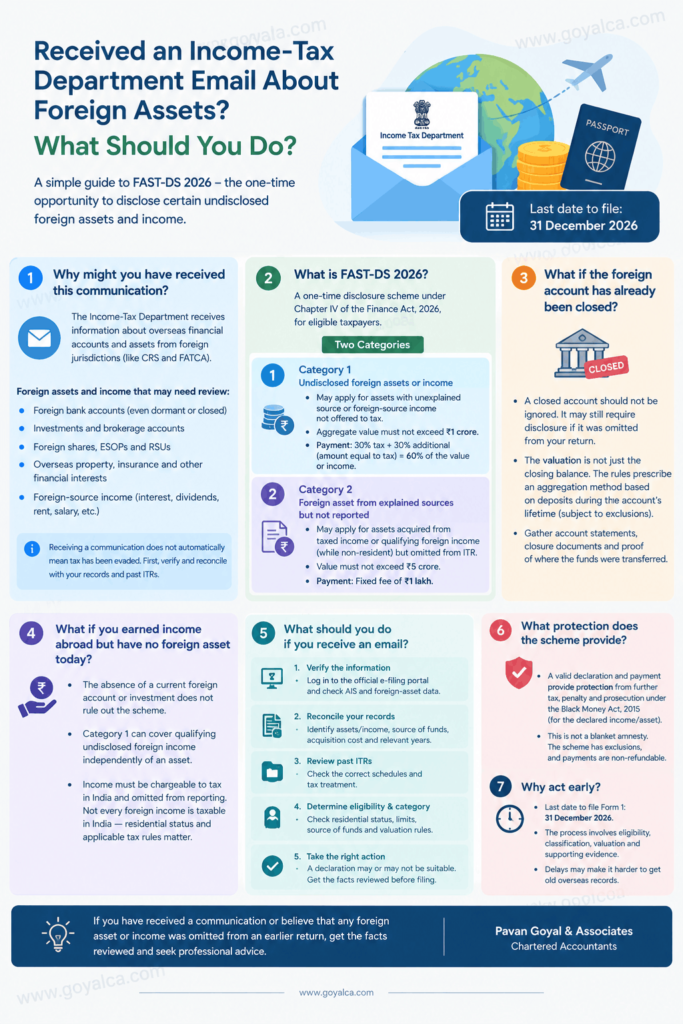
FAST-DS 2026: A one-time opportunity to address certain undisclosed foreign assets and income
Have you received an email or SMS from the Income-Tax Department asking you to review foreign assets or income that may not have been reported in your Income-Tax Return (ITR)?
You are not alone! The Department receives information about overseas financial accounts and certain financial assets through international information-sharing arrangements. Differences between this information and the disclosures made in an ITR may prompt the Department to ask taxpayers to review their records.
For eligible taxpayers, the Government has introduced the Foreign Assets of Small Taxpayers – Disclosure Scheme, 2026 (FAST-DS), providing a time-bound opportunity to disclose specified foreign assets or income, subject to prescribed conditions and payment.
The deadline for filing a declaration under the scheme is 31 December 2026.
1. Why might you have received this communication?
Information about your overseas financial interests may be available to the Indian tax authorities even if you have not actively used the account or investment for several years.
Examples of foreign assets and interests that may require review include:
- Bank accounts opened while studying or working abroad, including dormant or subsequently closed accounts.
- Foreign shares, brokerage accounts and investments.
- Foreign employer shares, including certain ESOPs and RSUs.
- Overseas property, insurance policies and other financial interests.
- Foreign-source income, such as interest, dividends, rent, salary or capital gains.
The fact that an account is dormant, has a low balance, or has been closed does not automatically resolve the disclosure question. Similarly, receiving a communication does not by itself establish that tax has been evaded or that every item mentioned is taxable in India.
The first step is to verify the communication and reconcile the information with your financial records and previously filed ITRs.
2. What is FAST-DS 2026?
FAST-DS is a one-time disclosure scheme under Chapter IV of the Finance Act, 2026. It covers specified undisclosed foreign assets and foreign income, as well as certain foreign assets acquired from explained sources that were omitted from the relevant ITR schedule.
The scheme has two principal categories.
Category 1: Undisclosed foreign assets or income
This category may apply where a foreign asset has an unexplained or unsatisfactory source of investment, or where foreign-source income chargeable to tax in India was not offered to tax.
The combined value of qualifying undisclosed foreign assets, measured as prescribed, and undisclosed foreign income must not exceed ₹1 crore.
The amount payable (as tax, interest, penalty, etc all inclusive) is:
- Tax at 30% of the prescribed value of the undisclosed foreign asset or the qualifying undisclosed foreign income; and
- An additional amount equal to that tax.
The effective payment is therefore 60% of the applicable declared value or income.
Category 2: Foreign asset acquired from explained sources but not reported
This category may apply where a foreign asset was acquired from income already offered to tax in India, or from qualifying foreign income earned while the taxpayer was non-resident, but the asset was not disclosed in the relevant return schedule.
The value of the qualifying foreign assets must not exceed ₹5 crore.
The prescribed payment is a fixed fee of ₹1 lakh. Kindly note – there is no separate tax but a fixed fee only irrespective of any quantum of foreign asset upto 5 crores.
Importantly, the ₹1 lakh fee is not a general settlement amount for every kind of foreign asset or income. If an asset has generated separate undisclosed taxable income, that income may require a separate classification and payment under the scheme.
The applicable category depends on the source of funds, the nature of the omitted disclosure, the taxpayer’s residential status and the statutory conditions.
3. What if the foreign account has already been closed?
A closed account should not be ignored merely because it no longer exists.
For example, an individual may have opened a foreign bank account while studying abroad, retained it for a few years and closed it after returning to India. The account may still require examination if it was omitted from a return in which disclosure was required.
The scheme’s bank-account valuation rules do not simply use the closing balance. They prescribe an aggregation method based on deposits during the account’s lifetime up to the specified valuation date, subject to exclusions to prevent double counting.
The relevant records should therefore be collected, including account statements, available closure documents and evidence showing where the closing funds were transferred. The specific treatment of an account closed before 31 March 2026 should be assessed with reference to the notified Rules and the available facts.
4. What if the income was earned abroad but there is no foreign asset today?
The absence of a current foreign bank account or investment does not automatically make the scheme unavailable.
Category 1 can cover qualifying undisclosed foreign income independently of an undisclosed foreign asset. However, the income must meet the scheme’s definition of foreign income chargeable to tax in India and must have been omitted from tax reporting.
Not every amount earned abroad is necessarily taxable in India. Residential status, the nature and source of income, the relevant financial year and applicable tax provisions must be examined before deciding whether a declaration is required or permitted.
5. What should you do if you receive an email?
We recommend the following steps:
Step 1 — Verify the information. Log in independently to the official Income-Tax Department e-filing portal and check the available Annual Information Statement (AIS) and foreign-asset information. Do not rely solely on an email attachment or an unfamiliar link.
Step 2 — Reconcile your records. Identify the assets and income concerned, the relevant years, the acquisition cost, the source of funds and whether the asset was subsequently sold or the account closed.
Step 3 — Review your previous ITRs. Foreign asset reporting and foreign-source income reporting are not identical. The relevant schedules and the tax treatment must be examined separately.
Step 4 — Determine eligibility and the correct category. Check the residential-status conditions, monetary limits, source-of-funds evidence, prescribed valuation and applicable exclusions. Do not assume that every foreign asset qualifies for the ₹1 lakh category.
Step 5 — Decide the appropriate course of action. Depending on the facts, the correct response may involve a FAST-DS declaration or a different compliance action. A declaration should not be filed merely because a communication has been received.
6. What protection does the scheme provide?
A valid declaration and payment provide the specified protection from further tax, penalty and prosecution under the Black Money (Undisclosed Foreign Income and Assets) and Imposition of Tax Act, 2015, in respect of the income or asset declared, subject to the scheme’s terms.
This is not an unconditional amnesty for every tax or regulatory issue. The scheme contains exclusions, and payments made under it are non-refundable. Eligibility and the financial consequences should therefore be reviewed before filing.
7. Why should the matter be reviewed promptly?
The last date for filing Form 1 under FAST-DS 2026 is 31 December 2026. The process involves more than completing a form: the taxpayer must establish eligibility, classify the asset or income correctly, compile supporting evidence and calculate the prescribed amount.
Waiting until the last few days may leave insufficient time to obtain old overseas bank statements, investment records, employer share-plan documents or evidence of the source of funds.
How can Pavan Goyal & Associates assist?
Pavan Goyal & Associates can assist in reviewing the Department’s communication, reconciling overseas information with past ITRs, evaluating residential status and source of funds, examining FAST-DS eligibility, determining the applicable category and prescribed valuation, and advising on the appropriate compliance action.
If you have received a communication regarding foreign assets or income, we recommend getting the facts reviewed before taking any action. The appropriate treatment depends on the circumstances of each taxpayer.
Official reference material
- Income-Tax Department: FAST-DS 2026 FAQs
- Finance Act, 2026 — Section 133: Amount payable under the scheme
- Income-Tax Department: FAST-DS portal and payment guidance
Disclaimer: This article is intended for general information and awareness. It is not a substitute for an examination of the taxpayer’s circumstances, applicable law and supporting records. Eligibility, valuation, payment and the protection available under FAST-DS 2026 are subject to the Finance Act, 2026, the notified Rules and the applicable conditions.
Author
Pavan Goyal and Associates (Chartered Accountants)
Office No. B212, GO Square, Mankar Chowk, Wakad, Pune 411057
Email – office@goyalca.com
Contact – 9762763351