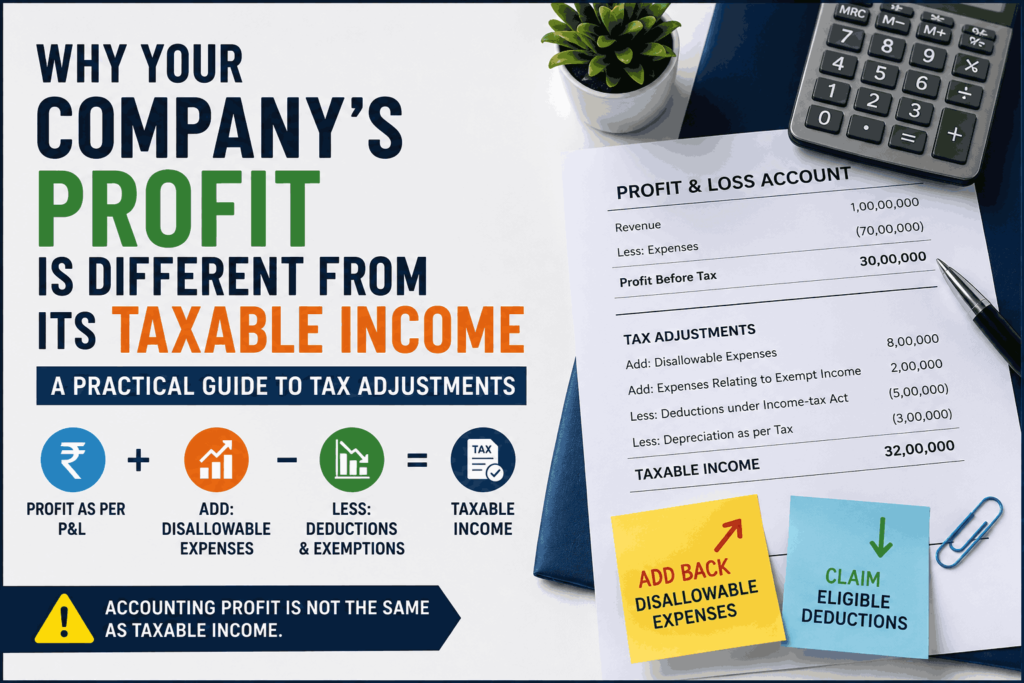
A common question asked by business owners is:
“Our company’s profit as per the Profit & Loss Account is ₹50 lakh. Why is taxable income ₹60 lakh?”
The answer is simple: accounting profit and taxable profit are not always the same.
Financial statements are prepared according to applicable accounting standards and accounting policies, whereas taxable income is determined by applying the provisions of the Income-tax Act, 2025.
As a result, certain expenses recorded in the books may not be deductible for income-tax purposes, while certain deductions or adjustments may be available for tax purposes even though they do not appear as an ordinary expense in the Profit & Loss Account.
Accounting Profit vs. Taxable Income
The starting point for computing taxable income of a company is generally the profit or loss as per its books of account.
This profit is then adjusted for items that are:
- Not allowable as a deduction under tax law;
- Allowable only subject to specified conditions;
- Allowable in a different year;
- Exempt or taxable differently; or
- Eligible for a specific deduction under the Income-tax Act.
A simplified computation can therefore look like this:
| Particulars | Amount (₹ lakh) |
|---|---|
| Profit before tax as per P&L | 50 |
| Add: Expenses not allowable for tax | 12 |
| Less: Income not taxable / separately considered | (2) |
| Less: Additional tax deductions | (5) |
| Taxable income | 55 |
Thus, taxable income is not necessarily the same as accounting profit.
1. Income-tax disallowances
One of the most important reasons for the difference is that certain expenses recorded in the Profit & Loss Account are not deductible under the Income-tax Act.
For example, an expense may be:
- Personal in nature;
- Capital in nature;
- Specifically prohibited by the Act;
- Incurred in violation of applicable law; or
- Subject to specific conditions that have not been satisfied.
Such expenses may remain in the financial statements but may have to be added back while computing taxable income.
2. Expenses relating to income-tax
Income-tax paid by a company is not normally deductible while computing its taxable business income.
Therefore, while preparing the tax computation, the income-tax expense appearing in the Profit & Loss Account is generally added back.
This is one of the simplest examples of why accounting profit and taxable income differ.
3. Depreciation – books vs. tax depreciation
This is one of the most common adjustments for companies.
Depreciation charged in the financial statements is calculated according to the applicable accounting requirements and the useful life of assets.
Tax depreciation, however, is determined according to the depreciation provisions of the Income-tax Act.
Therefore:
Book depreciation ≠ Tax depreciation
For example:
| Particulars | ₹ lakh |
| Depreciation as per books | 20 |
| Depreciation allowable under tax law | 15 |
| Difference added back | 5 |
The difference may reverse in subsequent years depending on the tax depreciation position.
4. Expenses subject to TDS compliance
Certain expenditure can have tax consequences where the applicable TDS provisions have not been complied with.
For example, where tax was required to be deducted from a payment but the required compliance was not made, the corresponding expenditure may be subject to disallowance under the applicable provisions.
Therefore, TDS compliance is not merely a compliance exercise—it can directly affect the company’s taxable income.
Companies should periodically reconcile:
Books → TDS liability → TDS returns → Tax payments
5. Certain payments made after the year-end
Some expenses may be recorded in the books for a particular financial year but their tax deductibility may depend upon when the payment is actually made.
Specified payments, including certain statutory liabilities and payments covered by the relevant tax provisions, may require adjustment based on the timing of payment.
This is why year-end tax provisions and outstanding statutory liabilities should be reviewed carefully.
6. Provisions and estimated expenses
A company may create provisions in its financial statements based on reasonable estimates.
However, an expense being provided for in the accounts does not automatically make it deductible for tax purposes.
For example, provisions relating to:
- Expected expenses;
- Disputed liabilities;
- Future obligations;
- General provisions; or
- Estimated losses
may require separate examination under the Income-tax Act.
The accounting treatment and tax treatment can therefore differ.
7. Penalties and expenses for violation of law
Not every expense incurred by a company is deductible merely because it has been recorded in the books.
Amounts incurred for purposes prohibited by law or penalties for certain violations may be disallowed under the applicable tax provisions.
Therefore, companies should distinguish between:
Normal business expenditure
and
penalties or expenditure arising from violation of law.
This distinction becomes particularly important during the year-end tax computation.
8. Expenses relating to exempt income
Where a company earns income that is not taxable, the corresponding expenditure may not necessarily be fully deductible.
The tax law contains specific provisions for determining expenditure relating to certain exempt income.
Accordingly, companies having investments, dividend income or other exempt income should review whether any corresponding tax adjustment is required.
9. Expenses that are allowable in a different year
Sometimes the expenditure is genuine and allowable, but not in the same year in which it is recorded in the books.
This creates a timing difference.
For example, an expense may be:
- Disallowed in the current year; and
- Allowed in a subsequent year when the relevant statutory condition is satisfied.
Therefore, a tax computation should not merely identify the current year’s additions. It should also maintain a year-wise record of temporary disallowances and subsequent deductions.
10. Certain deductions available only under the Income-tax Act
The difference can also arise in the opposite direction.
A company may be entitled to a deduction under the Income-tax Act even though the corresponding amount is not recorded as a normal expense in the Profit & Loss Account.
Consequently, taxable income can sometimes be lower than accounting profit.
This is why tax computation is not simply a process of adding back expenses.
A simple example
Suppose a company has the following Profit & Loss Account:
| Particulars | Amount (₹ lakh) |
| Profit before tax | 100 |
| Included in the above: | |
| Book depreciation | 20 |
| Income-tax expense | 10 |
| Provision requiring tax adjustment | 5 |
Assume tax depreciation allowable is ₹25 lakh.
The broad tax computation would be:
| Particulars | ₹ lakh |
| Profit before tax | 100 |
| Add: Book depreciation | 20 |
| Add: Income-tax expense | 10 |
| Add: Provision requiring adjustment | 5 |
| Less: Tax depreciation | (25) |
| Taxable income before other adjustments | 110 |
Thus, although the company’s accounting profit is ₹100 lakh, its taxable income could be ₹110 lakh.
The exact computation will depend on the nature of each item and the applicable provisions.
Why companies should maintain a tax reconciliation
A company should ideally maintain a reconciliation between:
Profit as per Financial Statements
↓
Tax adjustments
↓
Taxable income
This reconciliation should preferably be maintained year after year.
It helps in:
- Preparing accurate income-tax returns;
- Explaining differences during tax assessments;
- Tracking disallowances that may become deductible in later years;
- Identifying missed tax deductions;
- Reviewing deferred tax implications; and
- Reducing errors in tax computation.
Accounting profit is not the final tax number
The most important point for business owners is that profit reported in the financial statements and taxable income serve different purposes.
Financial statements aim to present a true and fair view of the financial performance and position of the company. Tax computation, on the other hand, applies the specific rules prescribed under tax law.
Therefore, a difference between accounting profit and taxable income is not, by itself, an indication of an error or tax problem.
The important question is whether the difference is properly identified, supported and adjusted in accordance with the applicable tax provisions.
Practical takeaway
Before finalising the company’s income-tax return, management should not simply take the profit from the audited financial statements and apply the tax rate.
A proper tax computation and reconciliation of accounting profit with taxable income should be prepared and reviewed every year.
This simple exercise can identify both unnecessary tax disallowances and missed tax deductions and can also provide strong documentation in the event of an income-tax assessment or notice.
Need Assistance with above concerns?
Contact Us!
Pavan Goyal & Associates helps businesses identify compliance risks and implement practical solutions for sustainable growth.
Author
Pavan Goyal and Associates (Chartered Accountants)
Office No. B212, GO Square, Mankar Chowk, Wakad, Pune 411057
Email – office@goyalca.com
Contact – 9762763351